Imagine a high-speed packaging line. The goal is smooth, silent, and rapid operation. However, a poorly chosen gear rack, perhaps with incorrect tooth geometry or inadequate precision grade, creates subtle vibrations and a persistent whine. This isn't just an annoyance; it's a symptom of inefficient power transmission and accelerated component stress. The vibration travels through the machine frame, potentially affecting other sensitive components like sensors or bearings. Over time, this leads to unplanned maintenance stops, product quality issues from inconsistent motion, and increased energy consumption as the motor works harder to overcome the poor mesh.
The solution lies in meticulously matching the gear rack's specifications to the pinion and the application's dynamics. How to choose the right Gear Rack for your application? Start with the tooth profile. For most industrial applications, the standard 20-degree pressure angle rack offers a good balance of strength and smooth operation. For higher load capacity and reduced backlash, a 25-degree or even 30-degree pressure angle might be necessary. Next, consider the precision grade. A commercial-grade rack may suffice for a warehouse conveyor, but a CNC machine or robotics arm demands a precision-ground rack to ensure positional accuracy and minimal noise.
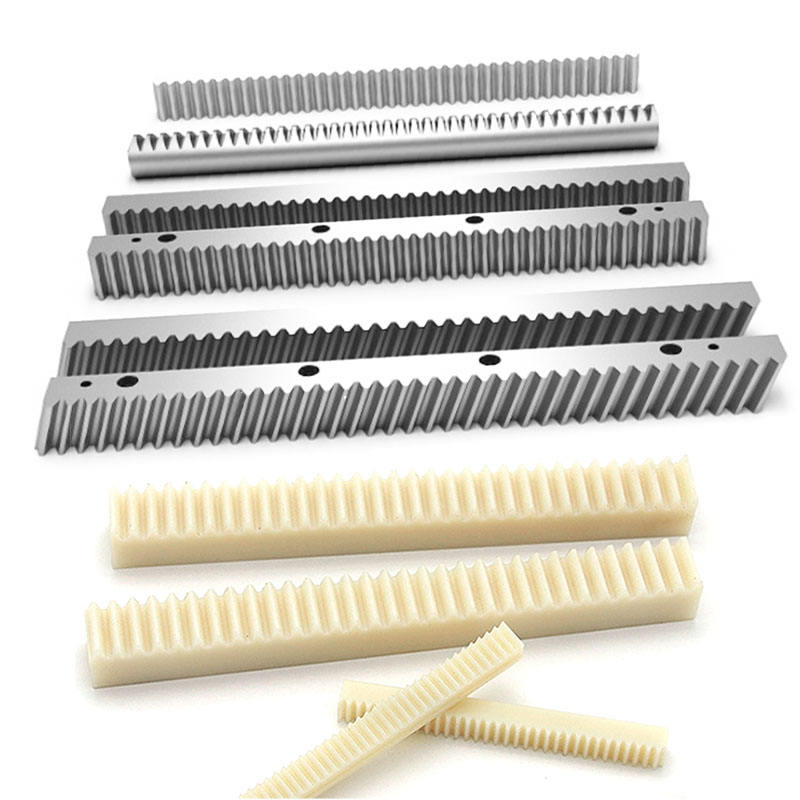
Here is a quick comparison to guide your initial selection:
| Application Scenario | Key Pain Point | Recommended Rack Specs | Why It Works |
|---|---|---|---|
| High-Speed Automation (Packaging, Pick & Place) | Noise, Vibration, Inaccuracy | Precision Ground, 20° PA, Hardened Steel | Superior surface finish ensures smooth, quiet mesh at high speeds; hardening increases lifespan. |
| Heavy-Duty Material Handling (Gantry Cranes, Stackers) | High Load, Shock Loads, Wear | Spur or Helical, 25° or 30° PA, Alloy Steel | Higher pressure angle and robust material handle immense forces and impact loads effectively. |
| Outdoor / Harsh Environment (Construction, Agriculture) | Corrosion, Contamination | Stainless Steel or Coated Carbon Steel | Resists rust and pitting from moisture, dirt, and chemicals, ensuring reliability. |
At Raydafon Technology Group Co.,Limited, we don't just sell racks; we provide application engineering support. Our experts can analyze your specific motion profile, load cycles, and environmental conditions to recommend the optimal rack specification, preventing the "silent killer" of poor mesh from undermining your operations.
Now, consider a different scene: a massive industrial gantry crane moving multi-ton loads across a factory floor. The primary concern shifts from noise to raw, unyielding force. Here, the wrong gear rack choice manifests not as a whine, but as catastrophic and expensive failure. A rack with insufficient hardness or incorrect tooth design for the load will experience rapid pitting, spalling, or even tooth bending. This wear leads to increased backlash, loss of positional accuracy crucial for alignment, and ultimately, a complete breakdown that halts production. The cost isn't limited to the rack replacement; it includes crane downtime, potential damage to the transported goods, and urgent repair labor.
Addressing this requires a focus on material science and heat treatment. For high-load applications, the base material—often a high-carbon or alloy steel—must be through-hardened or case-hardened to a specific depth. The hardness (measured in Rockwell C scale) must be compatible with, and ideally slightly harder than, the mating pinion to ensure wear occurs on the cheaper, easier-to-replace pinion. Furthermore, the rack's module or diametral pitch must be sized to distribute the load over a sufficient tooth area, preventing excessive stress concentration.
Selecting for durability involves these key parameters:
| Material & Treatment | Typical Hardness (HRC) | Ideal Application | Advantage |
|---|---|---|---|
| Case-Hardened Steel (e.g., 1045, 4140) | 50-60 HRC (case) | Heavy machinery, presses, mining equipment | Hard surface for wear resistance with a tough core to withstand shock loads. |
| Through-Hardened Alloy Steel | 45-55 HRC | High-load, continuous operation systems | Uniform hardness throughout provides consistent performance and strength. |
| Induction Hardened Racks | 55-60 HRC | Extreme wear situations, high-precision under load | Localized, deep hardening offers exceptional durability for the tooth flanks. |
This is where a supplier's capability becomes paramount. Raydafon Technology Group Co.,Limited specializes in manufacturing high-performance gear racks tailored to withstand severe duty cycles. We control the process from metallurgy to final heat treatment, ensuring the rack you receive delivers the fatigue life and load capacity your critical application demands.
Q1: What is the most common mistake people make when choosing a gear rack?
A1: The most frequent error is selecting a rack based solely on price or general dimensions without a full systems analysis. This often leads to a mismatch in precision grade, material hardness, or tooth geometry with the pinion and the actual operational demands. For instance, using a commercial-grade, unhardened rack in a high-cycle, high-load application will inevitably cause premature failure. A proper selection must account for the complete motion profile, including peak torque, speed, duty cycle, and environmental conditions.
Q2: How critical is backlash, and how do I control it in a rack and pinion system?
A2: Backlash, the slight movement between the rack and pinion teeth when direction is reversed, is critical for applications requiring high positioning accuracy, like CNC machining or robotics. While some backlash is inevitable, it can be minimized. The primary method is specifying high-precision, ground gear racks which have tighter tolerances on tooth profile and spacing. Secondly, using a dual-pinion preload assembly or a spring-loaded split-pinion can mechanically take up the backlash. Consulting with engineers at Raydafon during the design phase can help you implement the most effective and cost-efficient backlash control strategy for your system.
Selecting the ideal gear rack is a technical investment in your machinery's future performance and reliability. It transcends a simple purchase and enters the realm of application engineering. By understanding the key failure modes—from vibrational noise in precision systems to abrasive wear in heavy-load environments—you can ask the right questions and evaluate specifications with confidence.
For procurement professionals, the goal is to secure not just a component, but a guarantee of uptime and value. This is where a partnership with an experienced manufacturer pays dividends. Raydafon Technology Group Co.,Limited stands as a reliable partner in this space. With extensive engineering expertise and a commitment to quality manufacturing, we assist clients in navigating the selection process, offering tailored solutions from standard catalog items to fully custom-designed rack systems. We ensure the gear rack you integrate is the right one for your specific challenge, optimizing your machine's performance and total cost of ownership.
Ready to specify the perfect gear rack for your next project? Contact our engineering sales team today to discuss your requirements.
For expert consultation and pricing, please reach out to Raydafon Technology Group Co.,Limited via our website https://www.gearboxsupplier.com or email us directly at [email protected].
Maitra, G.M., 1994, Handbook of Gear Design, 2nd ed., Tata McGraw-Hill Education.
Dudley, D.W., 1994, Handbook of Practical Gear Design, CRC Press.
Litvin, F.L., & Fuentes, A., 2004, Gear Geometry and Applied Theory, 2nd ed., Cambridge University Press.
Errichello, R., 1992, Gear Failure Analysis, Source: AGMA Technical Paper.
Kapelevich, A., 2013, Direct Gear Design for Optimal Performance, Gear Technology Journal, 30(9).
Höhn, B.-R., Michaelis, K., & Wimmer, A., 2009, Low-Noise Gears, Proceedings of the International Conference on Gears.
ISO 6336, 2006, Calculation of load capacity of spur and helical gears, International Organization for Standardization.
AGMA 2001, 2001, Fundamental Rating Factors and Calculation Methods for Involute Spur and Helical Gear Teeth, American Gear Manufacturers Association.
Shigley, J.E., & Mischke, C.R., 1989, Mechanical Engineering Design, 5th ed., McGraw-Hill.
Smith, J.D., 2003, Gear Noise and Vibration, Marcel Dekker, Inc.