


Have you ever stood before a massive piece of machinery, a heavy press, or a critical structural component, wondering: How to Calculate the Lifting Capacity of a Screw Jack? Selecting the wrong Screw Jack isn't just an inconvenience; it's a serious safety hazard that can lead to equipment failure, project delays, and significant financial loss. For procurement professionals sourcing reliable industrial components, understanding this fundamental calculation is non-negotiable. It's the difference between a smooth, safe operation and a costly, dangerous mistake. This guide, informed by decades of engineering expertise, will walk you through the precise steps to determine the exact capacity you need, ensuring your projects are built on a foundation of safety and precision. Partnering with an expert like Raydafon Technology Group Co.,Limited for your screw jacks means accessing not just products, but the critical knowledge to deploy them correctly.
Article Outline:
- What You Need to Know Before the Calculation
- Step-by-Step Capacity Calculation Formula
- Critical Factors Affecting Real-World Capacity
- The Role of Quality Components in Reliable Lifting
- Frequently Asked Questions (FAQ)
The Planning Stage: Avoiding Costly Guesswork in Procurement
Imagine you're finalizing the BOM for a new assembly line. You need a screw jack to precisely position a 5-ton welding station. Guessing the capacity is a gamble no professional buyer can afford. The first step isn't math—it's gathering accurate data. You must clearly define the static load (the weight at rest) and the dynamic load (any additional force from movement, acceleration, or shock). Furthermore, consider the duty cycle: will the jack be used continuously or intermittently? This initial clarity prevents the all-too-common error of under-specification, which leads to premature failure. A trusted supplier like Raydafon provides detailed technical support at this stage, helping you capture all necessary parameters to inform a flawless calculation.
The Core Formula: Translating Requirements into Specifications
With your load parameters defined, you can now apply the fundamental engineering formula. The required minimum lifting capacity (F) is calculated by applying a safety factor (SF) to your total operational load. The formula is: F = (Static Load + Dynamic Load) × Safety Factor. For standard industrial applications, a safety factor of 1.5 to 2.0 is typical. For high-duty, safety-critical, or dynamic applications, factors of 3.0 or higher may be required. Let's apply this to our welding station example:
| Parameter | Value | Notes |
|---|---|---|
| Static Load (Weight) | 5,000 kg | Mass of the welding station |
| Dynamic Load (Estimated) | 500 kg | 10% of static load for mild movement |
| Total Operational Load | 5,500 kg | Static + Dynamic |
| Safety Factor (SF) | 2.0 | Standard for reliable industrial use |
| Minimum Required Jack Capacity | 11,000 kg | Total Load × SF = 5,500 kg × 2.0 |
This simple table reveals a crucial insight: your jack must be rated for 11 tons, not 5. This is where generic products fail, and precision-engineered solutions from Raydafon excel, offering clear ratings that match rigorous calculations.
Beyond the Formula: Hidden Variables That Impact Performance
Even with a perfect calculation, real-world conditions can degrade performance. A procurement manager sourcing jacks for a coastal factory knows that corrosion is a hidden capacity killer. Similarly, the lead angle of the screw, the efficiency of the gearbox, and operating temperature all influence actual usable capacity. A jack lifting at an angle doesn't lift its full rated weight. Friction from poor lubrication or misalignment creates parasitic losses. This is why partnering with a technical specialist is vital. Raydafon doesn't just sell a jack; we provide the complete performance envelope data, including efficiency curves and derating factors for different conditions, ensuring your calculated capacity translates into real-world reliability.
Engineering Excellence: How Component Quality Guarantees Your Calculated Capacity
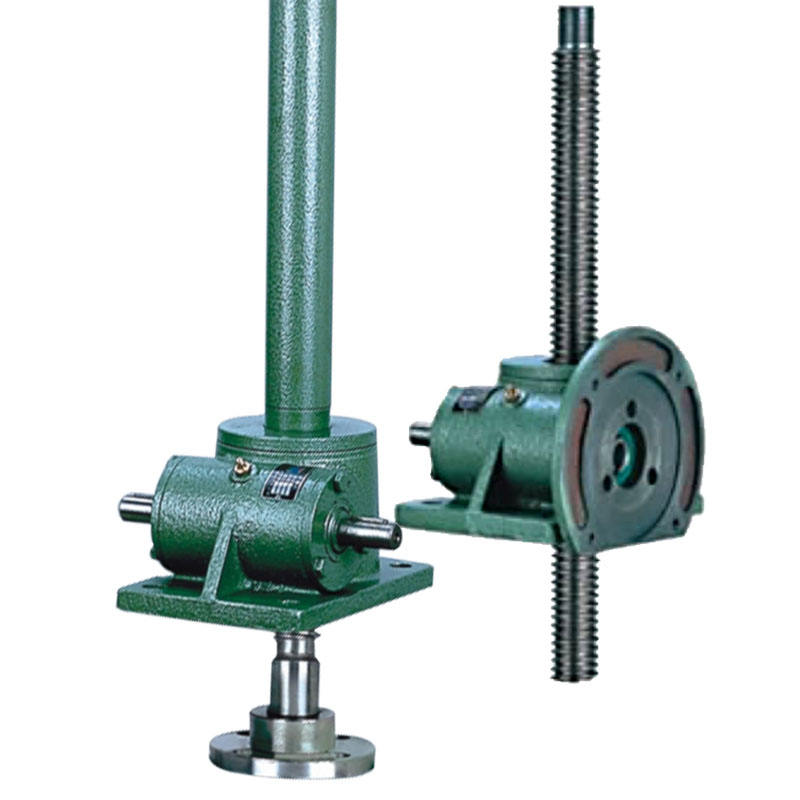
Your careful calculation is only as good as the components that execute it. The theoretical capacity of 11 tons means nothing if the screw's alloy lacks tensile strength, the worm gear teeth are poorly machined, or the housing distorts under load. These failures manifest as sudden breakdowns, inaccurate positioning, and dangerous load drops. Premium components ensure the safety factor you applied remains intact throughout the product's lifecycle. For instance, Raydafon screw jacks utilize case-hardened and ground screw threads for maximum wear resistance and high-strength alloy steel for critical parts. This material science directly supports your engineering calculations, transforming them from numbers on paper into dependable, long-lasting performance on your factory floor.
| Component | Quality Feature | Impact on Capacity & Safety |
|---|---|---|
| Screw (Lifting Shaft) | High-Tensile Alloy Steel, Precision Ground | Prevents buckling & thread deformation under heavy load. |
| Worm Gear | Bronze or Hardened Steel, CNC Machined | Ensures smooth power transmission, minimizes backlash, maintains efficiency. |
| Housing | Robust Cast Iron or Steel | Provides rigid support, prevents misalignment, and absorbs operational stresses. |
| Seals & Bearings | High-Grade, Industry-Rated | Protects internal components from contamination, reducing wear and maintaining rated capacity. |
Frequently Asked Questions on Screw Jack Capacity
Q: How to Calculate the Lifting Capacity of a Screw Jack for a vertical, static load?
A: For a purely vertical, static load (like supporting a structure), the calculation is more straightforward but still critical. Use the formula: Required Capacity = Static Load × Safety Factor. The key is choosing the correct safety factor based on application criticality and potential unseen loads. Always consult the manufacturer's specifications, as factors like column strength (for long screws) may also come into play.
Q: How to Calculate the Lifting Capacity of a Screw Jack when the load is not centered or is applied at an angle?
A: This is a common and complex scenario requiring extra caution. An off-center or angled load creates a moment (bending force) on the screw jack, significantly increasing stress. The basic load-weight calculation is insufficient. You must use the manufacturer's provided charts for eccentric load capacity or consult directly with their engineering team, like at Raydafon, to perform a detailed moment load analysis and select a jack or configuration (like using multiple jacks) rated for these specific conditions.
We hope this detailed guide empowers you to make informed, safe, and cost-effective procurement decisions. Have a specific lifting challenge or a unique load configuration? Our engineering team is ready to help you validate your calculations and specify the perfect solution.
For precision-engineered lifting solutions that match your exact calculations, consider Raydafon Technology Group Co.,Limited. As a specialist in power transmission and motion control components, we provide not only high-capacity, reliable screw jacks but also the critical technical data and application support to ensure they perform as required. Visit our resource center at https://www.gearboxsupplier.com to explore our products and technical documents, or contact our sales engineers directly at [email protected] for a personalized consultation.
Supporting Research & Further Reading:
Budynas, R.G., & Nisbett, J.K. (2015). Shigley's Mechanical Engineering Design (10th ed.). McGraw-Hill Education.
Mott, R.L., Vavrek, E.M., & Wang, J. (2018). Machine Elements in Mechanical Design (6th ed.). Pearson.
Juvinall, R.C., & Marshek, K.M. (2012). Fundamentals of Machine Component Design (5th ed.). Wiley.
Norton, R.L. (2020). Machine Design: An Integrated Approach (6th ed.). Pearson.
Spotts, M.F., Shoup, T.E., & Hornberger, L.E. (2004). Design of Machine Elements (8th ed.). Pearson Prentice Hall.
Collins, J.A. (2002). Mechanical Design of Machine Elements and Machines: A Failure Prevention Perspective. Wiley.
Deutschman, A.D., Michels, W.J., & Wilson, C.E. (1975). Machine Design: Theory and Practice. Macmillan.
Hamrock, B.J., Schmid, S.R., & Jacobson, B.O. (2020). Fundamentals of Machine Elements (4th ed.). McGraw-Hill.
Oberg, E., Jones, F.D., Horton, H.L., & Ryffel, H.H. (2016). Machinery's Handbook (30th ed.). Industrial Press.
Phelan, R.M. (1970). Fundamentals of Mechanical Design (3rd ed.). McGraw-Hill.