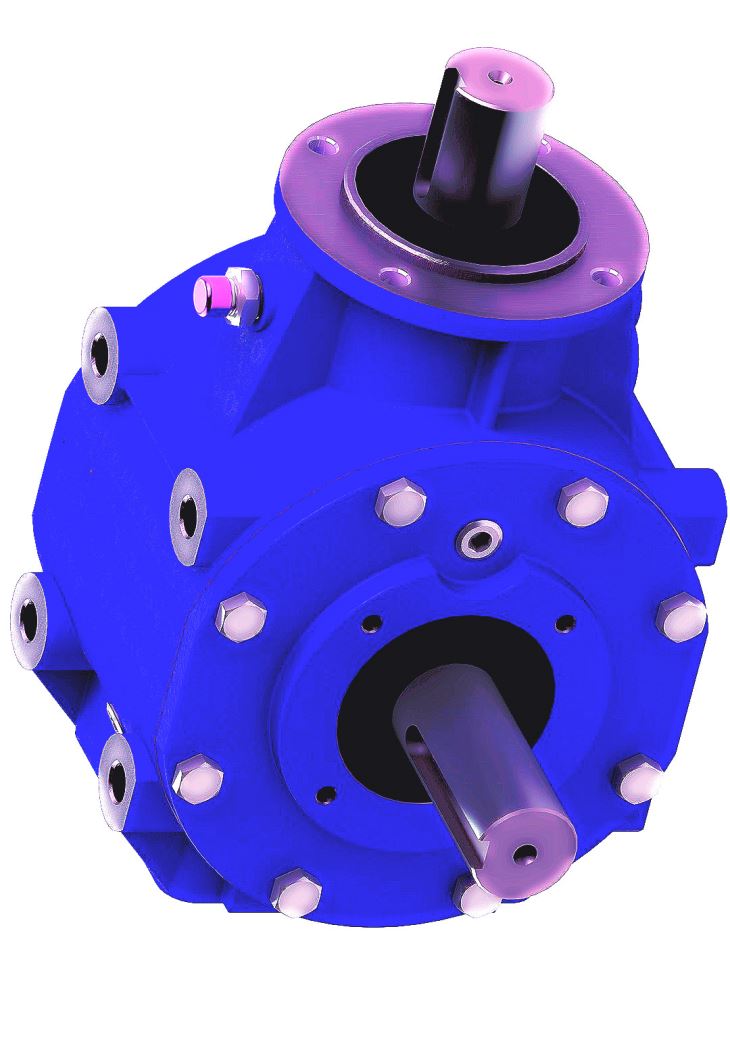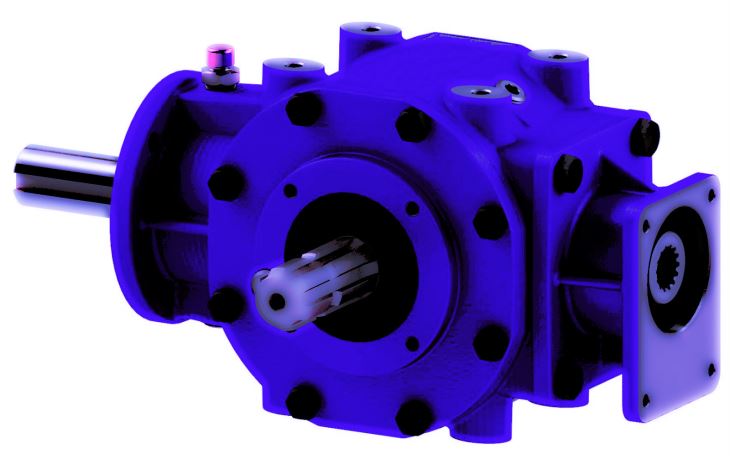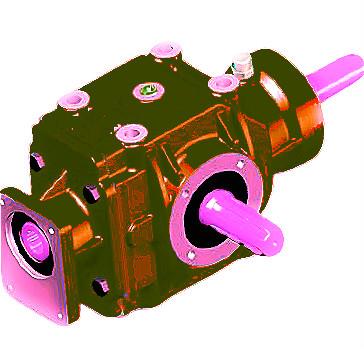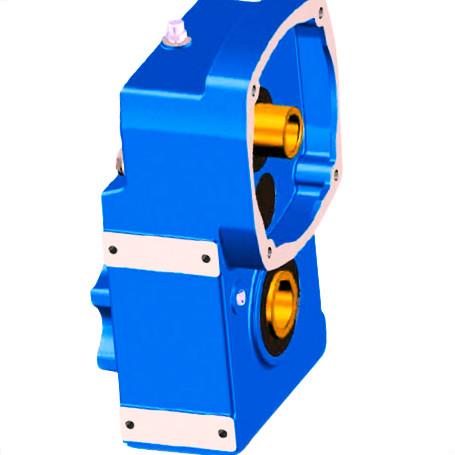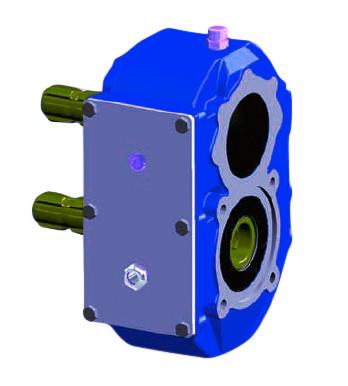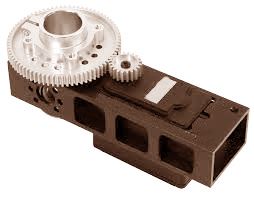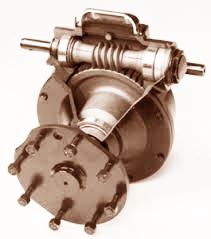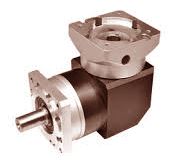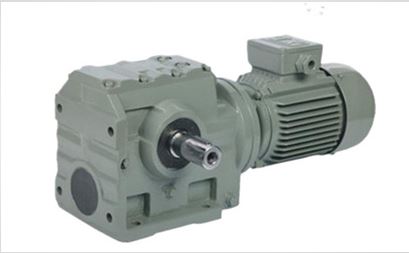
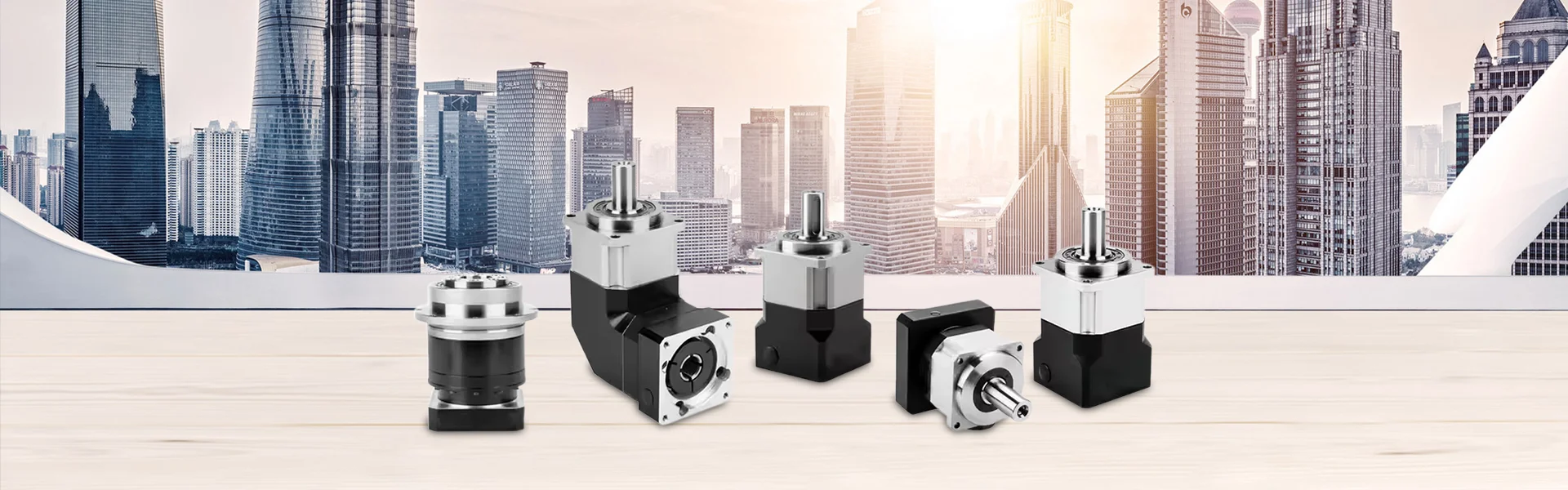
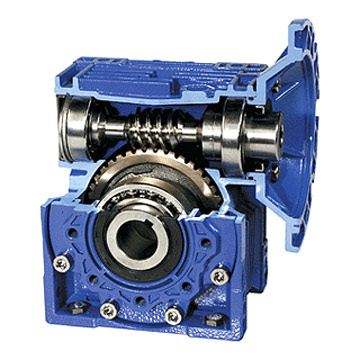
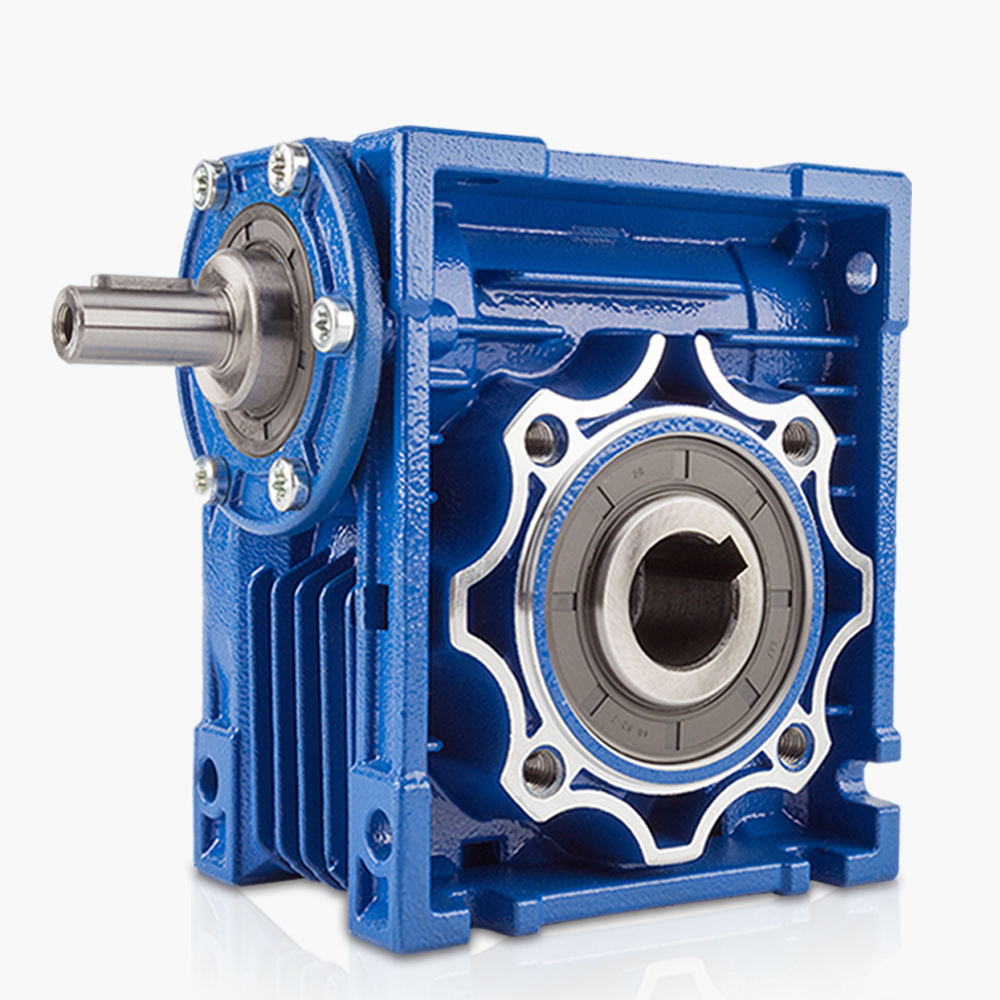
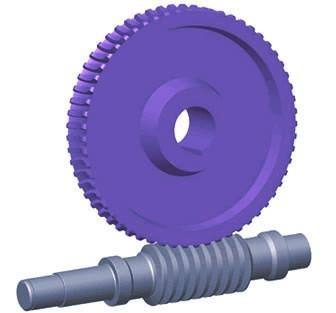
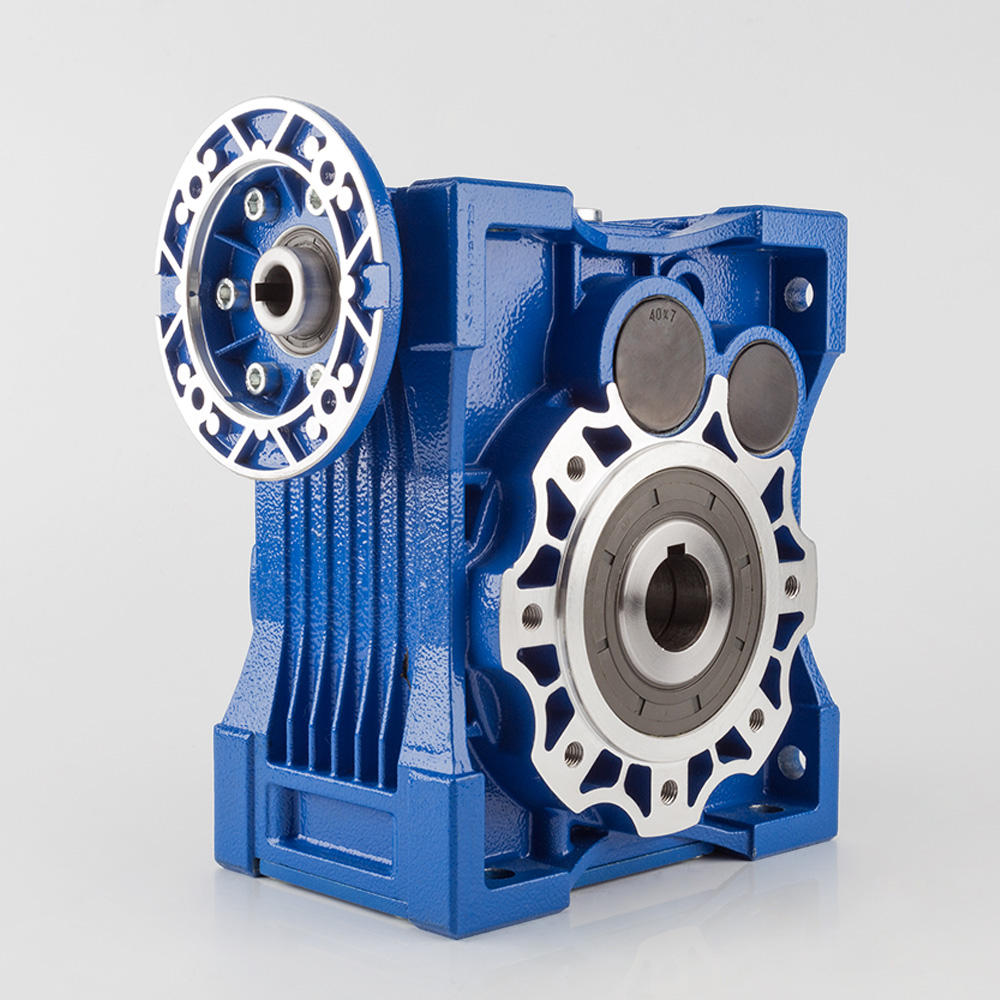
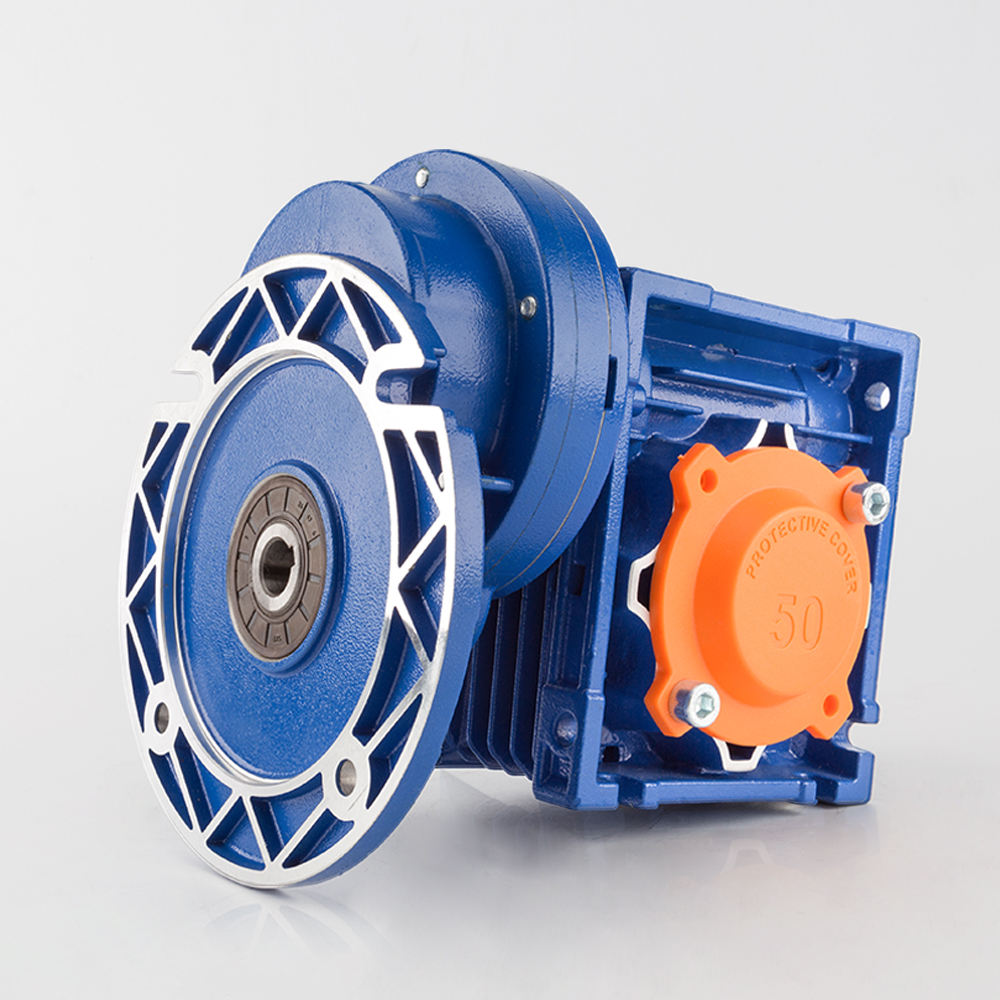
A worm gear reducer supplied as a complete geared motor unit, built on an aluminium alloy housing with NAK oil seals and NSK bearings. The 1:40 ratio is one of the standard worm gear ratios available in the range: with a 4-pole motor at 50 Hz the output speed is 35 rpm. Ratio, motor power, frame size and output flange are selected to the duty, not fixed by the catalogue.
A 1:40 ratio worm gearbox motor is a right-angle geared drive that takes a standard motor input and delivers it at one fortieth of the speed with a corresponding multiplication of torque. The 1:40 reduction is one of the standard ratios in the worm gear range, which is why it appears so often on conveyors, mixers, packaging lines and gate drives where a compact right-angle unit is needed and the output speed required is in the tens of rpm rather than hundreds.
This unit is built on an aluminium alloy housing — lighter than cast iron, with better heat dissipation per unit of weight, which matters because a worm gearbox generates more heat than any other single-stage reducer. The oil seals are NAK and the bearings are NSK or an equivalent in-house bearing, depending on frame size. The reducer is supplied as a complete geared motor: the worm shaft accepts a standard IEC motor flange, or the unit is delivered with the motor already fitted so it can be commissioned as one assembly.
Sizing a worm reducer is not the same as sizing a helical or planetary unit. Because the worm gearbox loses more energy as heat, the limiting factor is often thermal capacity rather than gear tooth strength — and because output torque rises in proportion to the ratio at the same input power, a 1:40 unit can be thermally overloaded long before it is mechanically overloaded. The sections below cover what to check. For the wider range, see the worm gearbox and gearbox and reducers catalogues, including the washdown-duty stainless steel worm gearbox.
The table gives the confirmed supply information for this gearbox. Frame size, motor power, ratio variants and output flange are configured to order, so the values that matter most are the ones taken from your duty calculation.
Scroll the table sideways on a mobile device to read every value.
| Item | Specification |
|---|---|
| Product type | Worm gear reducer, supplied as complete geared motor |
| Reduction ratio | 1:40 (standard ratio in the worm gear range) |
| Output speed at 1400 rpm input | 35 rpm |
| Housing material | Aluminium alloy |
| Colour | Blue |
| Oil seals | NAK oil seals |
| Bearings | NSK bearings and in-house bearings |
| Output configuration | Supplied with output flange |
| Shaft arrangement | Right angle, worm shaft input to worm wheel output |
| Gear ratio range available | Confirm available ratios and whether 1:40 is the ratio required for your duty |
| Frame size | Confirm against required output torque |
| Rated output torque | Confirm per frame size and ratio |
| Motor power and pole count | Confirm; standard IEC motors at 50 Hz or 60 Hz |
| Mounting position | Confirm; oil fill level depends on mounting orientation |
| Lubrication | Mineral or synthetic worm gear oil according to the operating temperature |
Values to confirm before publication: frame size, rated output torque, available ratio steps, motor power range, service factor and mounting positions are marked as unconfirmed because they are frame-specific and cannot be inferred from the ratio alone. Please fill these from the gearbox catalogue or the sizing sheet. A gearbox page without a rated output torque cannot be selected by an engineer — output torque is the single figure a buyer needs first, and it is currently missing.
Three numbers decide whether a 1:40 worm unit is the right choice: the output speed it produces, the output torque it must deliver, and the efficiency at which it does so. Speed and torque favour the worm gearbox. Efficiency does not, and that trade-off is the whole reason a worm reducer is chosen or rejected.
Output speed follows directly from the ratio and the input speed:
n₂ = n₁ ÷ i n₂ = output speed, n₁ = motor speed, i = reduction ratio
At 50 Hz a 4-pole motor runs at approximately 1400 rpm under load, so a 1:40 unit gives 35 rpm at the output shaft. A 2-pole motor at 2800 rpm gives 70 rpm at the same ratio. Because the ratio is fixed by the gear set, the output speed is normally tuned by choosing the motor pole count or by fitting a variable frequency drive rather than by changing gears.
Output torque rises in proportion to the ratio, reduced by the efficiency of the gear train:
T₂ = T₁ × i × η T₂ = output torque, T₁ = motor torque, i = ratio, η = efficiency
This is why a 1:40 unit produces substantial torque from a small motor — and also why it can be thermally overloaded long before it is mechanically overloaded. The gear teeth may be rated far above the duty, while the oil temperature reaches its limit because 25–50 % of the input power is being converted to heat inside the housing rather than transmitted to the load. Selection must therefore be checked against both mechanical and thermal capacity, and the service factor must account for the actual duty cycle, not just the running torque.
A worm gearbox is the least efficient of the common reducer types, and the effect becomes more pronounced as the ratio increases. A single-stage 1:40 unit typically runs at roughly 50–75 % efficiency, compared with about 95–96 % for a helical or planetary reducer of the same ratio. The comparison below is indicative rather than a specification:
The efficiency penalty is not a defect — it is the price of the two things the worm gearbox does better than anything else. First, it achieves a large reduction in a single compact right-angle stage, where a helical unit would need two or three stages and considerably more space. Second, at high ratios the sliding contact between worm and wheel makes the drive self-locking or near self-locking, so a load cannot back-drive the gearbox when the motor stops. On a hoist, a gate, a sluice or an inclined conveyor, that property removes the need for a separate brake.
When not to choose a worm gearbox: if the duty runs continuously at high load, if energy consumption is the deciding factor, or if a ratio below roughly 1:10 is required, a helical or planetary reducer will use substantially less power for the same output. The worm gearbox wins where space is tight, where a right-angle drive is needed, where the ratio is large, or where self-locking matters more than efficiency.
Most premature worm gearbox failures trace back to three causes: the wrong mounting orientation, the wrong oil quantity, and a duty cycle that was never checked against the thermal rating. All three are avoidable at installation.
| Mounting position | The oil level plug is positioned for a specific mounting orientation. A unit mounted in an orientation other than the one it was filled for can run with too little oil at the worm wheel or with the seals submerged. State the mounting position when ordering, and check the level plug after installation. |
| Oil grade and quantity | Fill to the level plug with the grade specified for the frame size and the expected ambient temperature. Synthetic worm gear oil is preferred where operating temperatures are high or where the duty runs continuously, because it resists thermal breakdown better than mineral oil. |
| Motor alignment | Where the motor is fitted to the input flange, check that the motor shaft enters the coupling without forcing it. Misalignment loads the input bearing and shows up later as noise or seal leakage at the input end. |
| First oil change | The first oil change is the most important one, because it removes the running-in wear particles produced while the worm and wheel bed in. Change at the interval in the manual, then at the normal service interval thereafter. |
| Temperature monitoring | Worm gearboxes run warm — that is normal. What matters is the stabilised temperature, not the transient. If the housing becomes too hot to touch after a normal working period, the unit is thermally overloaded and the duty, ambient temperature or oil grade needs review. |
| Seal inspection | Check the input and output seals periodically. A weeping seal on a worm unit usually indicates either a worn seal or excessive internal pressure from overfilling or overheating; replacing the seal without correcting the cause will not hold. |
| Vent and breather | Confirm the breather is clear and correctly positioned for the mounting orientation. A blocked breather pressurises the housing and pushes oil past the seals. |
| Backlash check | Worm drives develop backlash as the wheel wears. Some increase over service life is normal; a rapid change indicates either inadequate lubrication or a duty above rating. |
The 1:40 worm gearbox motor suits drives that need a compact right-angle reduction to a low output speed, with moderate to high torque and an intermittent or moderate duty cycle.
| Output speed required | Work backwards from the process speed. Ratio is then fixed by the available motor speeds, or the motor is selected to suit the ratio. |
| Output torque and service factor | Calculate the running torque, then apply a service factor for the starting duty and shock loading of the application. A conveyor starting fully loaded needs a higher factor than a mixer starting empty. |
| Thermal capacity | Check the duty cycle and ambient temperature against the gearbox thermal rating. Continuous duty in a hot environment is the most common cause of worm gearbox overheating. |
| Self-locking requirement | Confirm whether the load must be held without a brake. Self-locking depends on ratio, lead angle and lubrication, so it should be confirmed for the specific unit rather than assumed from the ratio. |
| Mounting and space | Confirm the mounting position, the available envelope and the output shaft or flange arrangement the driven machine requires. |
| Environment | Standard aluminium units suit normal industrial environments. Washdown, corrosive or outdoor locations call for a sealed or stainless steel variant. |
Matching a worm reducer to its motor is a system decision, not a component decision. Where the driven machine needs a flexible or misaligned connection, the drive train usually includes a coupling between motor and gearbox, and where the reaction torque must be absorbed on a shaft-mounted unit a torque arm is used. Send the duty data and we will size the complete assembly rather than the gearbox alone.
Send the required output speed and torque, motor power and supply, duty cycle, ambient temperature, mounting position and output arrangement. We confirm frame size, ratio, service factor and thermal suitability, and reply with a quotation for the complete geared motor unit.
Request a Quotation* Efficiency figures are typical indicative values for single-stage worm, two-stage helical and two-stage planetary reducers at comparable ratios, and vary with frame size, ratio, load and lubrication. Output speed figures assume motor speed under load. Frame size, rated output torque, available ratio steps, motor power range and service factor are confirmed against your duty data in the quotation.
Address
Luotuo Industrial Area, Zhenhai District, Ningbo City, China
Interested in our gearboxes or custom components?
Contact Raydafon for a prompt quotation and technical support. As responsive Manufacturers from China, we ensure clear communication and tailored solutions for every inquiry.