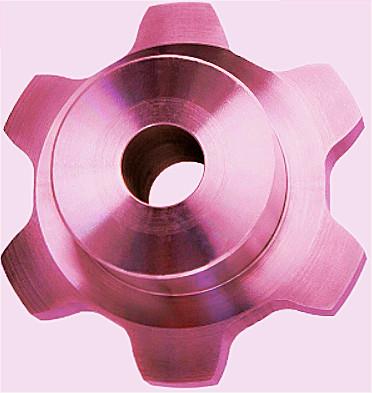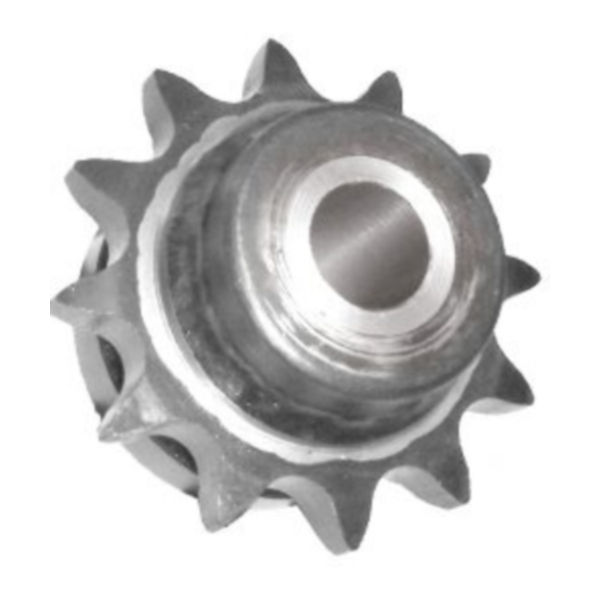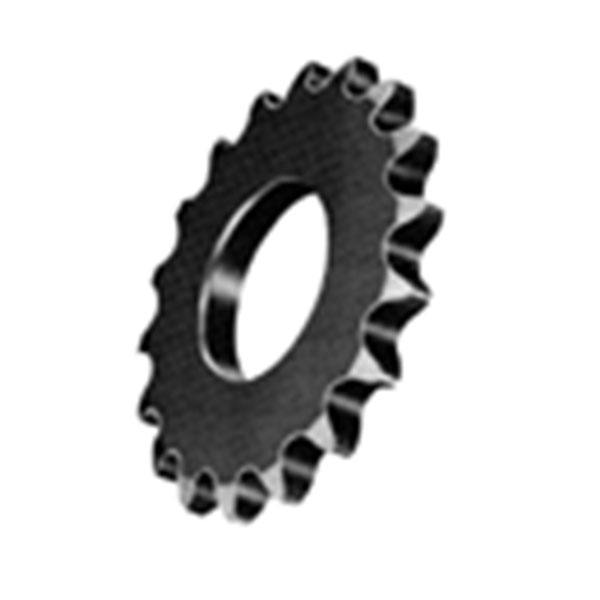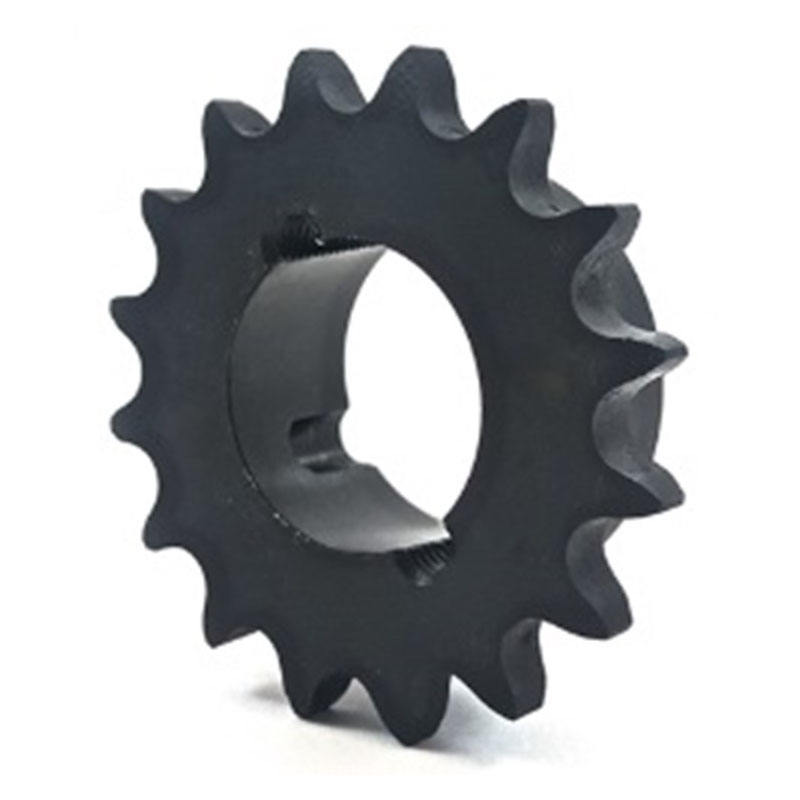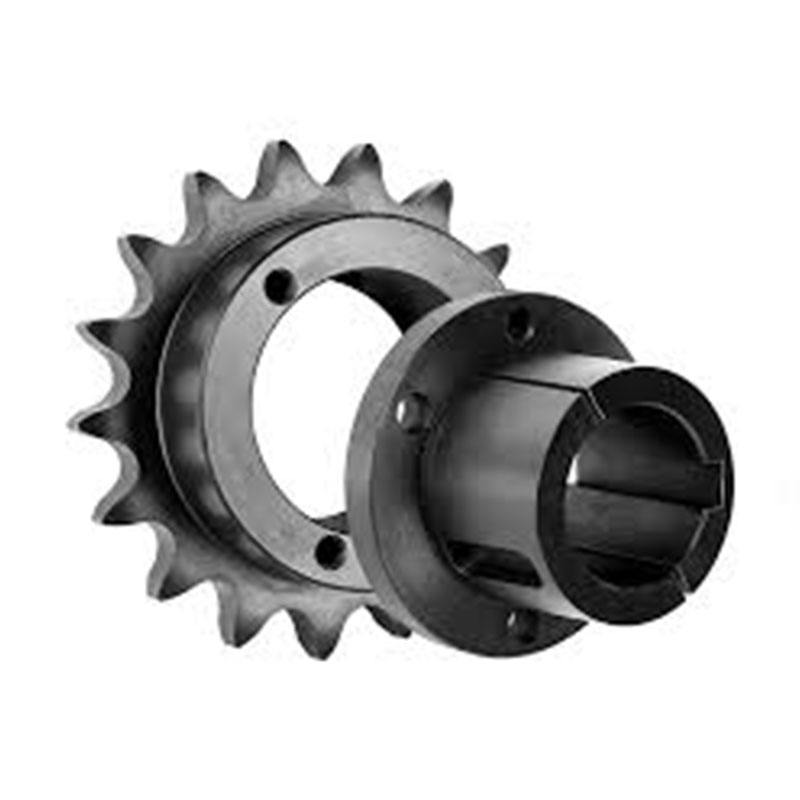
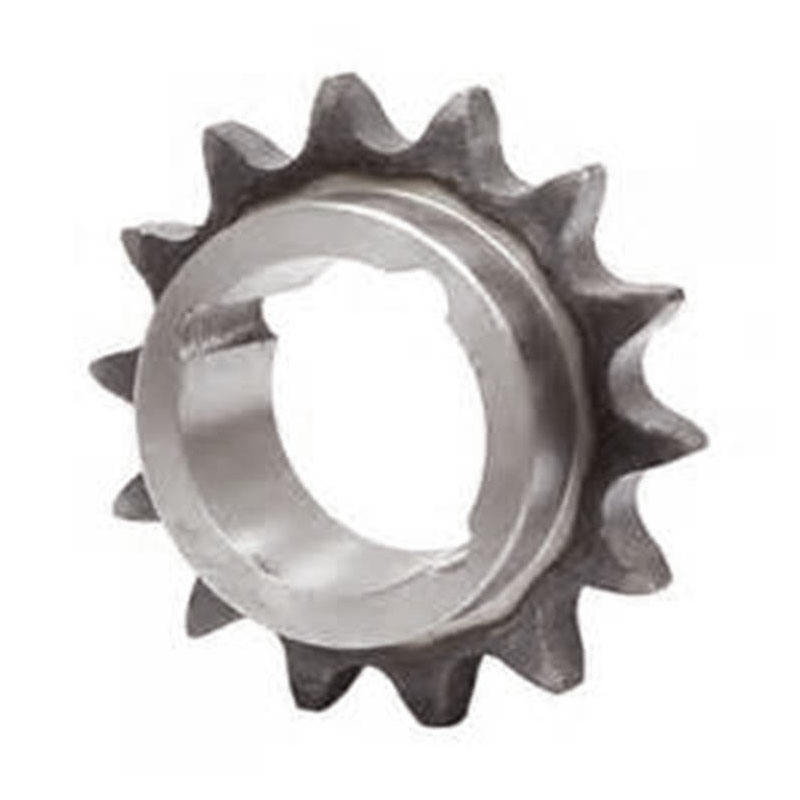
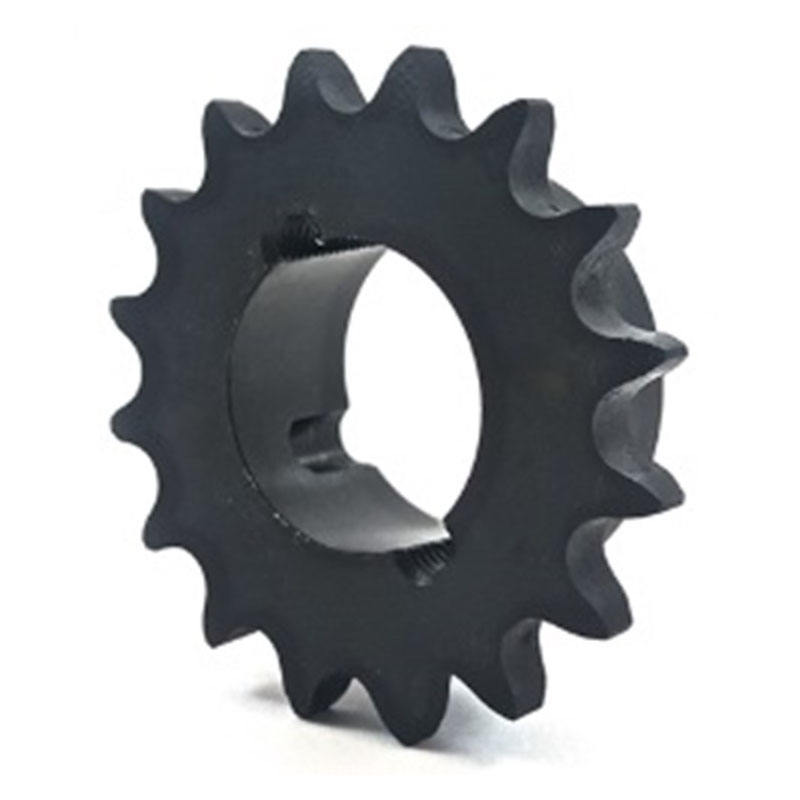
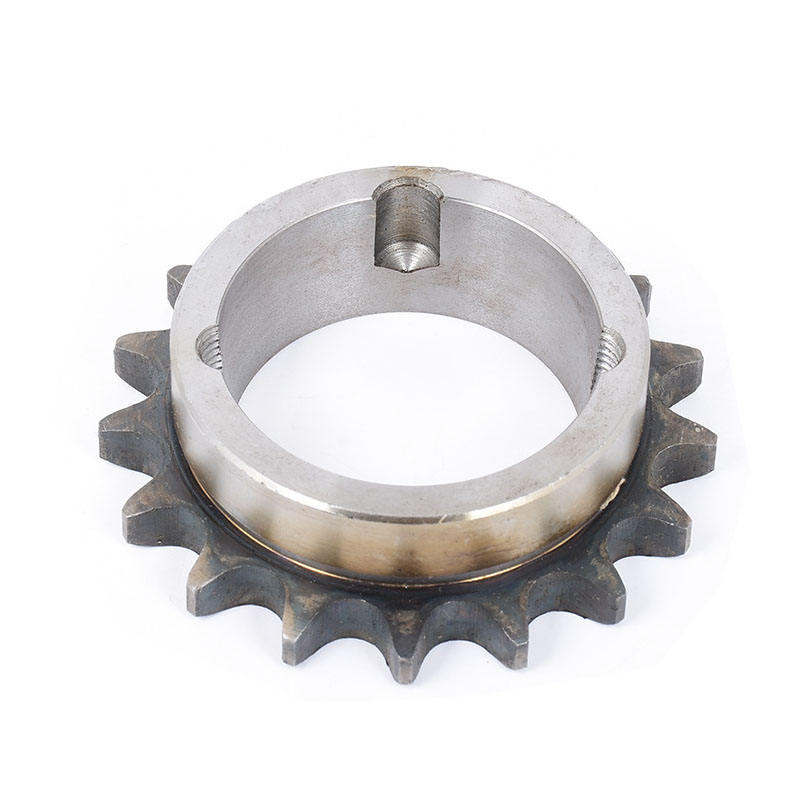
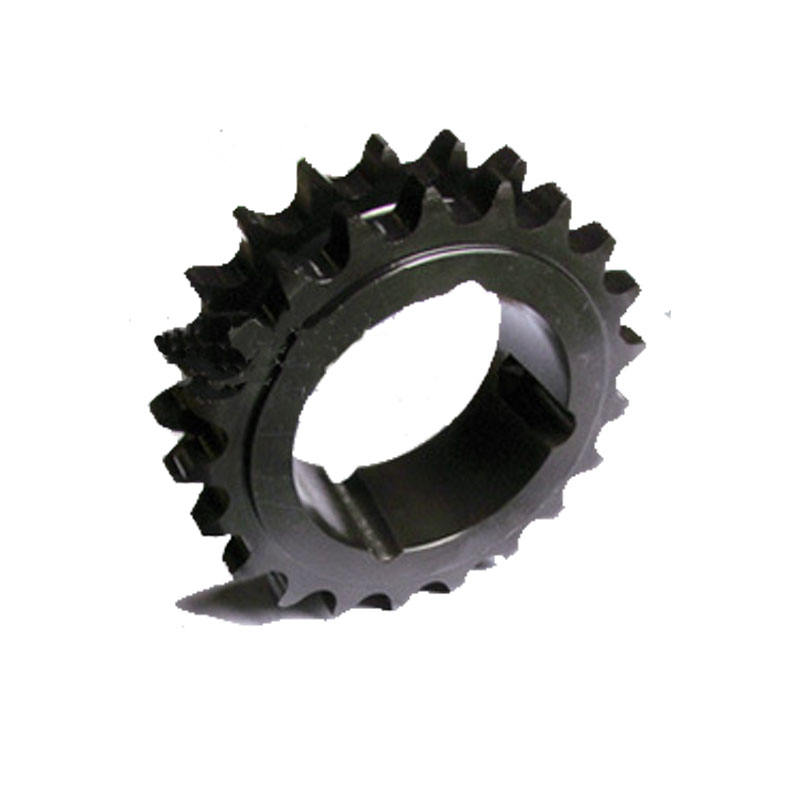
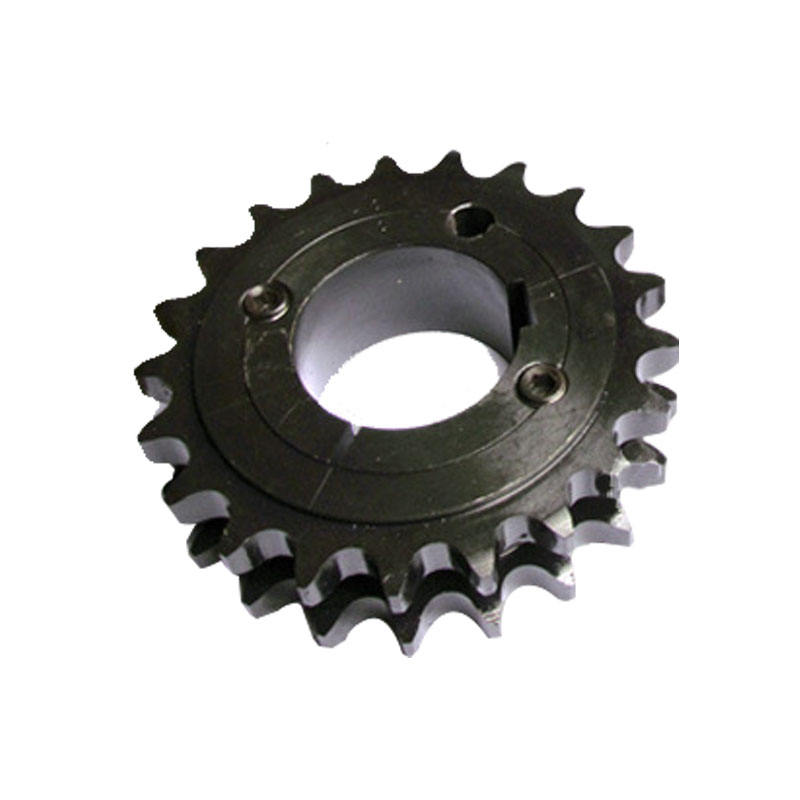
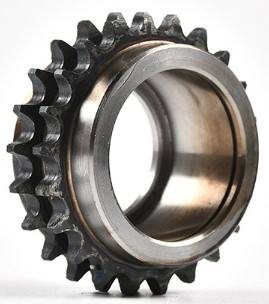
A single-strand #40 roller chain sprocket with a B type hub, bored 1 inch and keyed, with hardened teeth and 12 teeth on a 1/2 inch pitch. Machined from AISI 1045 medium carbon steel with a 2.16 inch outside diameter. The B type hub gives a single-sided projection that mounts against a bearing or shoulder, and the hardening raises the tooth flank hardness so the sprocket wears at the chain interface rather than deforming under load.
A sprocket is a toothed wheel that meshes with a roller chain to transmit power. As the sprocket turns, the teeth engage the chain rollers and drive whatever the chain is connected to. The sprocket and the chain are a matched pair: choosing the right sprocket matters as much as choosing the right chain, because a sprocket of the wrong pitch, tooth count or bore will not transmit load correctly and will wear the chain out early.
This unit is a 12-tooth, single-strand sprocket for #40 (1/2 inch pitch) roller chain, with a B type hub — one hub projecting from one side of the plate. Twelve teeth is the low end of the practical range for a drive sprocket: it gives the largest speed reduction for a given pair, but it also imposes the highest chordal action on the chain, so it is normally used as the small driver sprocket rather than as a driven sprocket where a smoother action is wanted.
Hardening is what separates a sprocket that lasts from one that rounds its teeth. An unhardened 1045 sprocket will work, but under shock loading or in an abrasive environment the tooth flanks deform and the pitch effectively grows, which accelerates chain wear. Inductively or flame hardened teeth hold their profile and keep the chain running at the correct pitch for far longer. The related chain and drive components are covered in the sprockets and chain ranges.
The full specification for this part is listed below. Every value is taken from the product data; where a figure needs confirmation before it can be used for design work, it is marked.
Two values to confirm before publication: the length through bore (stated as 0.875" against a 1" bore, which is not geometrically possible) and the hardening specification (no hardness value or case depth is given anywhere on the page, even though "hardened" is the headline feature). Length through bore and hardness are the two figures a mechanical designer needs to complete a sprocket selection, and both are currently unusable.
For comparison when selecting adjacent tooth counts, the standard dimensions for a #40 (1/2" pitch) single-strand sprocket are as follows. The 12-tooth unit on this page is highlighted:
Standard ANSI 40 sprocket dimensions. Scroll the table sideways on a mobile device.
| Teeth | Pitch dia. (in) | Outside dia. (in) | Typical bore range (in) |
|---|---|---|---|
| 12 | 1.932 | 2.16 | 1/2 – 1 |
| 13 | 2.089 | 2.33 | 1/2 – 1 |
| 14 | 2.247 | 2.49 | 1/2 – 1 |
| 15 | 2.405 | 2.65 | 1/2 – 1 |
| 16 | 2.563 | 2.81 | 1/2 – 1 |
| 17 | 2.721 | 2.97 | 1/2 – 1 |
| 18 | 2.879 | 3.13 | 1/2 – 1 |
| 19 | 3.038 | 3.29 | 1/2 – 1 |
| 20 | 3.196 | 3.44 | 1/2 – 1 |
| 21 | 3.354 | 3.60 | 1/2 – 1 |
| 24 | 3.829 | 4.08 | 1/2 – 1 |
| 30 | 4.780 | 5.03 | 1/2 – 1 |
| 36 | 5.732 | 5.98 | 1/2 – 1 |
| 40 | 6.368 | 6.62 | 1/2 – 1 |
Pitch diameter is calculated as pitch ÷ sin(180° ÷ number of teeth). For 12 teeth on a 1/2" pitch this gives 1.932", which corresponds to the 2.16" outside diameter quoted above. The comparison table is a standard reference for ANSI 40 sprockets; confirm the actual dimensions of any specific tooth count against the supplier drawing before designing around it.
Hardening is the difference between a sprocket that holds its tooth profile for years and one that rounds off and takes the chain with it. Understanding what hardening actually does explains why the specification on this page needs to state a hardness value rather than only the word "hardened".
Hardening specification to supply: please state the tooth flank hardness (for example 45–50 HRC), the effective case depth in millimetres, and the hardening method (induction or flame). Without these three figures, the word "hardened" on this page is a claim a buyer cannot check — and it is the single feature that distinguishes this part from an unhardened sprocket at a lower price.
Five factors determine whether a replacement sprocket will work in an existing drive. Working through them in order avoids the most common mistake, which is ordering the correct tooth count on the wrong pitch.
The sprocket must match the chain. A #40 sprocket has a 1/2" pitch; a #41 chain also has a 1/2" pitch but a different roller diameter, so the sprockets are not interchangeable. Confirm the chain number stamped on the chain itself rather than measuring the pitch alone.
Type A is a flat sprocket with no hub, mounted by bolts through the plate. Type B, the style of this part, has a single hub projecting from one side and is the most common configuration, mounting against a shoulder or bearing. Type C has a hub on both sides and is used where the sprocket is supported on both faces.
Tooth count sets the speed ratio and the smoothness of the drive. Fewer teeth gives a larger reduction but more chordal action, more noise and faster chain wear. Twelve teeth is the practical minimum for a driver sprocket; below that the polygonal effect becomes severe. As a rule, use the largest driver sprocket the ratio allows.
The bore must match the shaft diameter, and this sprocket is supplied with a 1" finished bore. The keyway must match the key: an undersized keyseat will shear the key under load, and an oversized one will allow the sprocket to rock on the shaft. Confirm the keyseat width and depth against the shaft specification.
The final factor is whether a standard or hardened sprocket is appropriate. Light, clean, intermittent drives are often served by a standard sprocket. Continuous duty, shock loading, abrasive dust or outdoor exposure justify hardened teeth, because the cost difference is small against the downtime of replacing a worn drive. Where corrosion rather than wear is the dominant problem, a stainless steel sprocket is the appropriate choice rather than a hardened carbon steel one.
Most premature sprocket failures are caused by installation errors rather than by the sprocket itself. Four points cover the majority of them.
Installation and maintenance guidance. Scroll sideways on a mobile device.
| Item | What to check | Why it matters |
|---|---|---|
| Shaft alignment | Driver and driven sprockets must be in the same plane, with the shafts parallel. Check with a straight edge across both sprocket faces before tensioning the chain. | Misalignment loads the chain against the side of the teeth, wearing both the sprocket flank and the chain pin joints well before their rated life. |
| Chain tension | Set the correct sag for the drive layout — typically 2 % of the centre distance on the slack side. Re-check after the first few hours of running. | An over-tensioned chain loads the sprocket teeth and shaft bearings; an under-tensioned chain whips, skips teeth and wears the tooth tips. |
| Key and keyseat fit | The key should be a light tap fit in both shaft and sprocket, with no rocking. Fit the set screw over the key where one is provided. | A loose key allows the sprocket to rock, which hammers the keyseat wider and eventually shears the key under load. |
| Lubrication | Lubricate the chain, not the sprocket. Apply oil to the inside of the chain link plates so it reaches the pin and bushing area. | Sprocket teeth need no lubrication, but an unlubricated chain wears its own pins, elongates, and then wears the sprocket by riding high on the teeth. |
| Chain elongation | Measure chain wear periodically. Replace the chain when elongation exceeds roughly 1.5 % of its original length. | A worn chain on a new sprocket will destroy the sprocket quickly, because the increased pitch no longer matches the tooth spacing. Replacing both together is normally the cheaper decision. |
| Tooth inspection | Look for hooked or sharpened tooth profiles, which indicate the sprocket is worn and has effectively increased its pitch. | A hooked sprocket will not release the chain cleanly and will accelerate wear on any replacement chain fitted to it. |
Replacing sprocket and chain together: a new chain on a worn sprocket, or a new sprocket on a worn chain, will both wear faster than a matched pair. Where the chain has elongated beyond about 1.5 %, replace both. The related drive components are listed under bushings and hubs and couplings for the same assemblies.
Send the chain size, required tooth count, shaft diameter, key size and hub length — or simply the drawing or the part number you are replacing. We confirm the sprocket configuration and the hardening specification, and reply with price, minimum order quantity and lead time.
Request a Quotation* Specification values are taken from the product data. Length through bore and tooth hardness are marked for confirmation because the stated figures are either not geometrically possible or not supplied. The dimensional comparison table is a standard ANSI 40 reference and is not a specification of this particular part. Confirm all dimensions against the supplier drawing before designing around them.
Address
Luotuo Industrial Area, Zhenhai District, Ningbo City, China
Interested in our gearboxes or custom components?
Contact Raydafon for a prompt quotation and technical support. As responsive Manufacturers from China, we ensure clear communication and tailored solutions for every inquiry.